Buyer's guide
Mileage tells you least about a used electric car
A used electric car is not an old car. The median model year of the full-electric cars traded in August was 2023, the median odometer reading 56,000 km and the median transaction price 34,900 €. You are buying an almost-new car at almost-new-car money, and that moves the checklist somewhere else entirely from the cheap end of the trade. This guide is for anyone weighing up their first used electric car, and it answers one question: what do you look at before you buy? The battery's state of health, the model year, the charging hardware and the suspension.

bilbil.fi
30/09/2026| 06:25 | 20 min read
In brief
- The median odometer reading of a traded full-electric car is 56,000 km, against 187,000 km across the whole market. A low reading still does not mean low wear.
- Of the inspections done on four-year-old electric cars, 19.6% ended in a fail, against 5.4% of those on petrol cars. The commonest faults are in the suspension arm joints and bearings.
- There is no single agreed way of calculating battery state of health, so two readings from the same car can differ. One reading is therefore not a measurement.
Three things get checked on a used electric car before anything else: the battery's state of health, what is actually behind the model year, and the suspension. The first two are invisible in the advert, and the third is where an almost-new electric car fails more often than the buyer expects. All three come up at the first periodic roadworthiness inspection (katsastus) at the latest, and that is exactly the age of the cars now on sale.
The reason the list differs from the cheap end of the trade is price. The median transaction price of a full-electric car traded in August was 34,900 €, against 9,950 € for the used market as a whole. The electric car buyer is at the expensive end, and the checklist there is a different one from the end where the repair bill exceeds what the car is worth.
What kind of car is a used electric car in Finland?
The electric car is not yet an old phenomenon in the used trade, and it shows directly in the age of the cars on offer. The median model year of a full-electric car traded in August was 2023, while the median model year across the market was 2014. For petrol cars the median is 2008 and for diesels 2012, which puts roughly fifteen years between electric and combustion cars. The odometer gap is just as steep: the median for a full-electric car is 56,000 km and for a diesel 280,000 km. Even second-hand, an electric car is a car whose first owner has only just let go of it.
- Electric 56,000 km
- Hybrid 80,000 km
- Plug-in hybrid 89,000 km
- Petrol 196,000 km
- Diesel 280,000 km
Price separates the electric car from the rest of the market more sharply than age does. Half of all August transactions fell between 3,500 € and 22,790 €, so the full-electric median sits inside the top quarter of the market. An electric car is therefore not a cheap car, even though one used car sale in ten is already electric: in August full-electric cars accounted for 10.0% of transactions.
- Petrol 5,480 €
- Diesel 7,900 €
- Hybrid 22,990 €
- Plug-in hybrid 27,690 €
- Electric 34,900 €
All used passenger cars on sale at this moment, whatever the fuel. The figure covers the whole market, of which full-electric cars are one part.
The top five was clear in August. Most sales went to the Polestar 2, followed by the Tesla Model 3, Tesla Model Y, Volkswagen ID.4 and Skoda Enyaq. The model-year differences of these five are worth learning, because they are where the sales are.
A young fleet changes the nature of the risk. A petrol car buyer can lean on what is known about a model over a long run: 1,589 different models were traded in August, and the cheap end is led by cars that have been repaired in Finland for decades. The electric top five has no comparable history, so the buyer has to lean on what can be measured on the individual car. And the individual car gets measured for the first time at its inspection, which is what these cars are now approaching.
Why does a low-mileage electric car fail its inspection?
According to Traficom, the Finnish Transport and Communications Agency, a passenger car goes through its first periodic inspection no later than four years after it was first put into service, and every two years after that. Once more than ten years have passed, it is inspected annually. A 2023 electric car is therefore exactly at the age where it meets its first inspection, and half of the full-electric cars traded in August were that model year or newer. The inspection counts say the same: Traficom recorded 31,432 inspections of electric cars in 2025, against 15,513 the year before.
The inspection is the point where a low odometer reading stops being reassuring. According to Traficom's 2025 figures, 19.6% of periodic inspections on four-year-old electric cars ended in a fail, against 5.4% for petrol cars of the same age and 10.8% for diesels. That is more than three times the petrol figure, and it turns on its head the assumption that a car driven little is a car worn little.
The cause is not the battery or the electric drive. According to Traficom, the commonest faults behind failures on four-year-old electric cars were play in the rear axle trailing arm bearing or upper arm joint, and play in the front lower arm ball joint. These are suspension joints, the part of a car that wears from the roads it is driven on rather than from engine hours.

Teemu Toivanen, a leading specialist at Traficom, puts the difference down to servicing practice: service intervals on combustion cars are based on both distance driven and time elapsed, whereas on an electric car they are often based on time alone, or there are no real services at all. In practice an electric car can be four years old, lightly driven and still never have been in a workshop. So ask the seller for the previous inspection certificate and the service history, and if neither exists, know that you are buying a car with no outside evidence of its condition.
The figure has to be read against the right benchmark. Across all passenger cars, Traficom reports that 30% of periodic inspections in 2025 ended in a fail, so measured against the whole fleet an electric car does well. That comparison is not the one that concerns a buyer, though: a four-year-old car is not in the same group as a fifteen-year-old one, and within its own age group an electric car fails more often than a petrol car. So an electric car is not a bad car. It is a bad four-year-old car, and the suspension is where that shows. The battery is not the thing that fails here, but it is still the thing that decides what the car is worth.
What does battery state of health actually tell you?
Battery state of health, or SoH, is a percentage saying how much of what the battery held when new is still there. The figure matters more to a buyer than the odometer, because it describes the condition of the one part that is not replaced as a service item. The EU battery regulation requires that from August 2024 the battery management system of an electric vehicle traction battery holds up-to-date data for determining state of health, and that whoever has lawfully bought the battery has the right to read it. The information is in the car, then, and it is worth asking for.
One reading should still not be taken as a measurement. State of health does not correspond to any single physical quantity, and there is no industry consensus on how to calculate it: a manufacturer may derive the figure from capacity, internal resistance, the number of charge cycles, temperature history or some combination of these, and the weighting can be a trade secret. The same car can therefore show two different figures by two different methods without either being wrong. Temperature, state of charge and time spent standing move the reading too.
Battery chemistry affects how reliable the reading is. Some electric cars use a lithium iron phosphate battery, whose voltage does not indicate state of charge as precisely as a nickel-based battery's does, so state of charge is worked out from current and time instead. That method drifts off course little by little, which is why the reading has to be recalibrated, for instance by resetting it at a full charge. A car that has stood on a forecourt for weeks can therefore show the wrong state of charge and, through it, the wrong range, and the fault lies in the arithmetic rather than in the battery. So ask when the car was last charged to full, and take the battery reading after a charge rather than before.
One battery reading, with nothing known about how it was taken, at what temperature and at what state of charge, is an estimate rather than a measurement. Two readings by the same method tell you more than one reading by two.
The EU's Euro 7 regulation gives a benchmark by setting a minimum battery durability requirement for new passenger cars. State of health has to stay at 80% or above from the start of life to five years or 100,000 km, and at 72% or above to eight years or 160,000 km. The requirement applies to new vehicle types from November 2026, so it does not bind a 2023 car at all. It does say what level the regulator treats as acceptable, and a used car's reading can be read against it.
What should you measure on the test drive?
The test drive starts with a phone call before you set off. Ask them not to charge the battery to full before you arrive: DC charging slows as the pack fills, so on a full battery you cannot see the charging rate at all. Ask at the same time what the car's own display showed the last time it was charged to full, and ask for the previous inspection certificate to be ready. None of these three requests costs anything, and together they decide whether you can measure anything once you are there.
Before you move off, write down four readings: the range estimate, the outside temperature, the odometer and the average consumption. Then drive the sort of route you would drive at home, and look at the same four readings again. That way you get your own figure instead of trusting the seller's, and the difference between the two readings tells you more than either one alone.

The season has to be read into it. According to Motiva, an electric car's range in freezing weather is about two thirds of the warm-season figure, and in the hardest frosts only half, so a test drive in January is not comparable with one in June. A sensible anchor for consumption is the figure Traficom uses in its fuel price comparisons: the reference consumption for mid-size electric SUVs is 20.6 kWh/100 km, and the official comparison price for electricity is 19.5 cents/kWh. If the car is in the same size class and its own average consumption in mild weather is higher than that, the reason is worth establishing before you buy.
The test drive is also where you listen for what fails cars of this age. Drive slowly over an uneven surface and listen for knocking from the suspension arms. Turn the wheel from lock to lock while stationary and listen to the front axle. Play in the joints is usually audible before it is visible, but a knock does not tell you which joint it comes from: if something knocks, write it down and get the car onto a ramp before you buy.
Where can you get an electric car checked before buying?
Play in the suspension does not show in an advert photo, and battery state of health does not show on a test drive, so at some point you need a ramp and a reader. In August 63.7% of used car sales were made by dealers and 36.3% by private sellers, and the difference shows in how easily a check is arranged: on a dealer forecourt the ramp is often on site, while in a private sale it has to be booked separately. Either works, but the latter needs arranging in advance. Time the inspection for the moment when you are ready to buy but have not yet paid, because that is when it is still of use.
A pre-purchase inspection covers both sides in one visit. Book it with a workshop that will lift the car and look specifically at the suspension arm joints and bearings, the very items that four-year-old electric cars fail on most. Ask at the same time to see the car's own report of battery state of health: under the EU battery regulation the data sits in the battery management system, and whoever has lawfully bought the battery has the right to read it. Showing the reading is therefore not a favour from the seller but the buyer's right.
The previous inspection certificate is the cheapest check on the whole list, and you get it by asking. Besides the pass or fail, it shows the advisory items: faults that did not yet stop the car being used but were on their way there. If the car has never been inspected, the first time is still ahead of it, and nobody has an outside assessment of its condition yet.
Why can two identical-looking electric cars be different cars?
Model cycles have run faster on electric cars than on combustion cars, and much of what changed is invisible from outside. Tesla thoroughly revised the Tesla Model 3 in 2023, and deliveries of the revised car began in most markets in October 2023, while in North America it only became orderable in January 2024. A car first registered in 2023 can therefore be either generation in Europe, and the registration document will not tell you which. The difference is in the body, the lights and the interior, and you have to recognise it from the photos before you compare two adverts.
The heat pump is another place where cars of the same model differ. The Tesla Model Y was the manufacturer's first car to heat the cabin with a heat pump instead of resistive heating, and the Model 3 got the same arrangement in an update in November 2020. In older Model 3 cars the heat is made with a resistor, which shows in winter range. A heat pump is not retrofitted, so you read it off the equipment list rather than the model name.
| Model | What changed | When | What to check on the car |
|---|---|---|---|
| Tesla Model 3 | Generation changed | Deliveries began in October 2023 | Body, lights and interior, not the registration year |
| Polestar 2 | Single-motor version became rear-wheel drive | Model year 2024 | Drivetrain from the registration document |
| Volkswagen ID.4 | Peak DC charging power rose | Software update in 2022 | Software version from the car |
Technology changes mid-life inside a model too. The single-motor Polestar 2 switched from front-wheel to rear-wheel drive for model year 2024, so two otherwise identical-looking cars can have different drivetrains. The peak DC charging power of the ID.4's largest battery, meanwhile, rose from 125 kW to 135 kW in an over-the-air software update, so the same car charges at different speeds depending on whether the update has been installed. Ask for the software version and check it on the car yourself.
What should you check about charging?
Charging involves two different things that are easily confused. Peak DC power is the figure a car is sold on, but everyday charging is decided by the car's own AC charger. That is hardware, not software: on the ID.4 the charger is 7.2 kW with the smallest battery and 11 kW with the larger ones, and no change of charging station makes the smaller one faster.
In Europe AC charging runs through a Type 2 connector and DC rapid charging through a CCS connector, and the same port handles both. According to Traficom, most charging points in Finland are AC points of at most 22 kW, which is exactly where the car's own charger becomes the bottleneck. Rapid chargers are fewer, and they sit along the route rather than in your own drive.
Home charging is worth sorting out before the car is in the drive. Tukes recommends charging from an ordinary domestic socket at no more than 8 A, and having a dedicated charging point installed at home from a 16 A or 32 A connection. Tukes also points out that in cold weather part of the charging current goes into warming the battery, so a car standing outside in winter charges more slowly than one kept warm. If there is no three-phase supply, the car's 11 kW charger is of no use.
The rapid charger test is worth doing on the same trip. Take the car to a charger with the battery well down and watch what power it climbs to and how long it holds there. A cold battery charges more slowly than a warm one, so in winter drive for half an hour first and only then go to the charger. If the power stays well below what the model promises, the reason is either temperature, software version or the battery, and the first two are easy to rule out by asking.
Which checks fall away on an electric car?
Some of the standard used car questions disappear entirely on an electric car. There is no clutch, no timing belt, no exhaust system or catalytic converter, and no engine oil to change. These are precisely the items the odometer has traditionally predicted, and once they are gone the reading loses most of its explanatory power. The same figure that tells you a lot about a petrol car tells you little about an electric one.
What is left is whatever wears regardless of what moves the car. Suspension and arm joints wear from the road, tyres wear from weight and driving style, dampers age with time, and body seals and electrics live the same life as in any other car. In these respects an electric car is an ordinary car, which is why an ordinary pre-purchase inspection is as necessary on it as on anything else.
So the checklist moves from one place to another rather than getting shorter. The time that goes on the engine bay and the exhaust on a combustion car goes on tyres, brake discs and suspension joints on an electric one. A buyer who opens the bonnet and skips the underside is checking the wrong side of the car.
Why do electric car brakes last and still break?
On an electric car part of the braking is done electrically: lift off the accelerator and the drive motor works as a generator, feeding power back into the battery. Energy recovery extends the life of the braking system, because discs, calipers and pads do not wear at the rate they do in a car that stops on friction brakes alone. Pad thickness is therefore a poor measure of condition: there can be plenty left relative to the distance driven.
The same cause turns into the problem. Brake discs are cast iron, and their friction surface stays clean with regular use; a car that has stood for a long time develops surface rust that only wears off once the brakes are used. A lightly and gently driven electric car is a worse case here than a heavily driven one, and a salted winter road does not help. Under Traficom's inspection criteria a brake disc is failed, or the car is banned from use, if it is rusted or corroded over more than a third of its friction surface on one side.
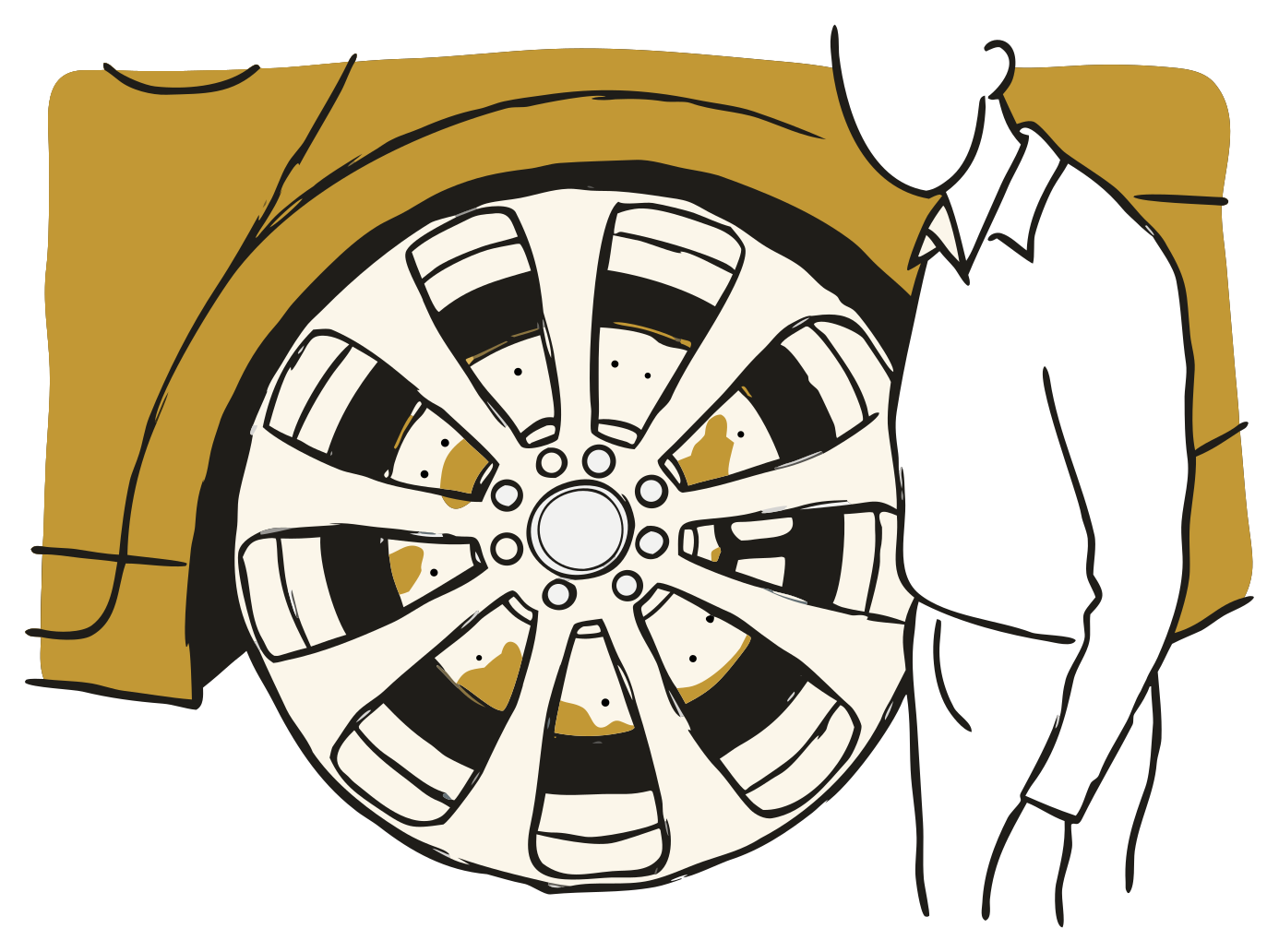
In practice this is the easiest check on the test drive. Brake hard once on a straight road and listen for scraping and feel for vibration through the pedal. Then look at the disc face between the wheel spokes and run a finger over the ridge at the outer edge. A seized caliper and the handbrake mechanism are typical faults of a little-used brake, and neither shows in the odometer. Brown surface rust on a car that has stood is a different matter from a corroded friction surface, and you tell them apart by whether the surface disappears after a few stops.
What does an electric car cost once the purchase price is paid?
Annual vehicle tax is lower on an electric car than on a diesel but not nil, and the amount depends on when the car was first put into service. According to Traficom, the basic tax on a full-electric car is 106.21 € a year if the car was put into service on or before 30 September 2021, and 171.18 € a year if it was put into service on or after 1 October 2021. The same model can therefore pay a different amount purely because of its service date. When you compare two otherwise similar adverts, that is one of the differences that does not show in the price but does show in the cost of ownership.
On top of the basic tax comes the propulsion tax, which on a full-electric car is 1.9 cents a day for each started hundred kilograms of gross weight. On a diesel the equivalent figure is 5.5 cents, so the gap is nearly threefold. For the price of electricity Traficom uses an official comparison figure of 19.5 cents/kWh, and set alongside the car's real consumption that makes the cost of driving calculable without the seller's promises.
Tyres are the cost that a low odometer reading hides most easily. According to Traficom, winter tyres must be used between 1 November and 31 March if the weather or road conditions require it, and the main grooves of a winter tyre must then be at least 3.0 mm deep; on a summer tyre the limit is 1.6 mm. Measure the tread depth yourself on both sets rather than inferring it from the mileage, because a little-used tyre can be an old tyre.
In what order should the checks be done?
The list is worth working through in the order things come up, not in the order of how important they are. Some of the checks have to be made before you set off to see the car, because otherwise the chance is gone: you cannot run a fully charged battery down on a dealer's forecourt.
- Before setting off: ask them not to charge the battery to full, and ask for the previous inspection certificate and the service history to be available.
- On the forecourt: tread depth on both sets of tyres, the brake disc friction surface and outer edge, and the heat pump on the equipment list.
- Before moving off: range estimate, outside temperature, odometer and average consumption written down.
- On the move: knocks and play from the suspension, scraping and vibration from the brakes, and the same four readings again after the drive.
- At the charger: DC charging power with the battery well down, and the car's own report of battery state of health.
Every item is on the list because it separates two identical-looking cars. With an electric car the deciding factor is not the odometer: the median reading of a traded full-electric car is about a third of the median across the market, and four-year-old electric cars still fail inspection more often than four-year-old petrol cars. When wear does not separate them, the battery, the model year and the suspension do.
The practical consequence is simple. On an electric car you pay almost-new-car money, so you check what you check on an almost-new car: battery state of health, software version, equipment list and suspension joints. At the cheap end the same decision is made on a mileage limit, but on an electric car a mileage limit does not separate one car from another. Mileage tells you less about an electric car than about any other used car. That is good news for anyone willing to measure other things, and bad news for anyone who only looks at the odometer.